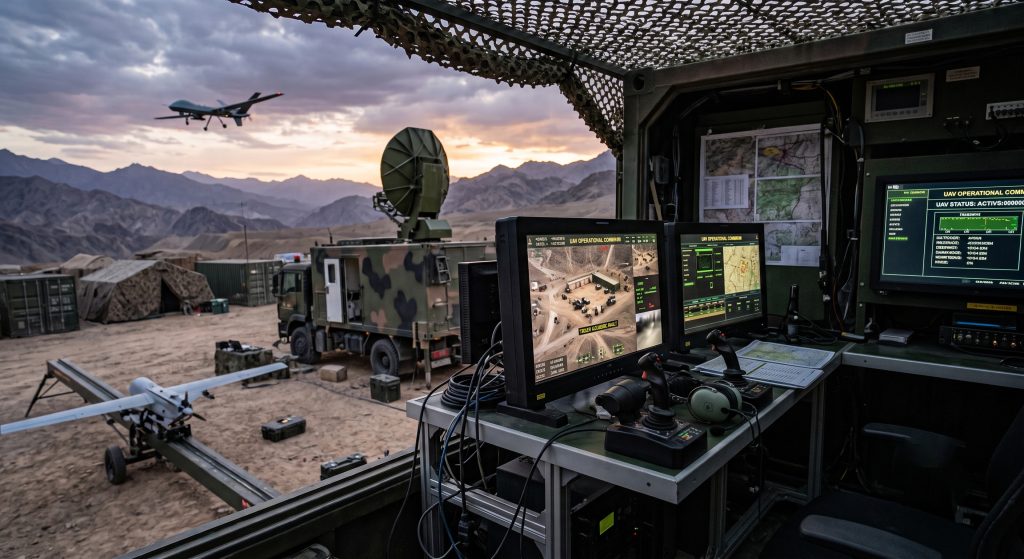
Reliable and Secure Communication for Mission-Critical Operations
Modern military and defense operations demand communication systems that provide exceptional reliability, ultra-low latency, and complete immunity to radio frequency interference. Traditional RF communication systems can be affected by electronic warfare, signal congestion, or intentional jamming, making them less suitable for high-risk environments.
Our Fiber Optic UAV Communication System provides a secure and interference-free transmission solution for military drones, enabling stable real-time video, telemetry, and command data transmission through lightweight optical fiber.
Challenges
Military UAV operations often face complex communication challenges, including:
- RF signal jamming and spoofing
- Electromagnetic interference (EMI)
- High-security data transmission requirements
- Long-duration reconnaissance missions
- Stable HD video transmission in contested environments
These challenges require a communication system that remains reliable even when traditional wireless links fail.
Our Solution
Our fiber optic communication system establishes a direct physical connection between the UAV and the ground control station through high-strength optical fiber.
The system supports:
- Full HD and 4K video transmission
- Ethernet communication
- Flight control data
- Telemetry transmission
- Low-latency command response
- Optional encrypted communication
Unlike conventional RF systems, fiber optic communication is immune to electromagnetic interference and does not emit radio signals, significantly improving operational security.
Key Advantages
- Zero RF interference
- Anti-jamming communication
- Ultra-low latency
- High bandwidth for multiple data channels
- Stable transmission over long distances
- Lightweight and compact design
- Easy integration with various UAV platforms
Typical Applications
- Battlefield reconnaissance
- Border surveillance
- Intelligence gathering
- Electronic warfare support
- Tactical command operations
- Special mission drones
Why Choose Our Fiber Optic Solution
With years of experience in UAV communication technology, we provide reliable fiber optic transmission systems designed specifically for professional drone applications. Our engineering team supports OEM and customized integration, helping customers develop secure and dependable UAV communication solutions for demanding environments.
Contact Us
Looking for a customized military UAV communication solution?
Contact our engineering team today to discuss your project requirements and receive professional technical support.